Thursday, July 5, 2012
My New Grandson, Odysseus
July 5, 2012
So.... why did I really want to go to the Met yesterday? Robby would have gone anywhere. True, Abigail wanted to see the Byzantium show before it closed, but I didn't particularly (and ended up awed, troppo awed, triple awed, and overwhelmed like finding a new, lush world nobody knew existed.
No, why I wanted to gotothemet was because the knob of my $29 watch I bought in 1999 has stuck so that I can't press in the knob to light up the dial at night and found I couldn't pull it out to change the hour from LA to NY, so I was permanently stuck like the watch 3 hours after the East Coast family. Whether you call it earlier or later I don't know, it was just making me schitzotempic.
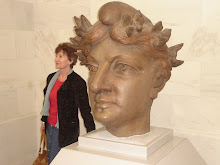
At the Met I knew they sold cheap fancy watches that look really classy. Tiffany styles, Egyptian, Old English, Van Gogh (pronounced Go like Go to the Met), Dali, square, rectangular, round, oval...
We made an immediate beeline to the main store (what a wealth of gifts for giddy museumgoers!) "Just like our kids," said Abigail, grinning. I was stuck between a rectangular aqua cubist watch and a round, golden, Greek Vase watch. Robby looked at the Greek Vase and said, "That's so YOU," so that's the one I bought. My wrist is a bit narrow for it but big is beautiful, isn't it? Or do I mean black? It has a black dial, gold circumference, gold hands and gold dots for numbers. It isn't lit up but the gold hands reflect any light at all, so it will do its best at night. The band is a bit wide but it's shiny black with a russet Attic vertical stylized lotus relief (Odysseus never knew about watches, did he?).
I love it!
Oh, did I mention I have a new grandson, 5 days old yesterday? I didn't? Oh ye gods, sorry, send me back to LA!
6/13/21 I had completely forgotten my blog, but pressing some button when Altoon sent her wonderful blog entry brought up my old blog, and this is what I see! New grandson! Nearly 9 years ago... Amitai the Odysseus, lots of imagination and loves traveling!

Wednesday, May 30, 2012
Bible Story in 3/3 Time
Adam he loved Eve.
She wore him on her sleeve
but first she had to sew,
while he learned how to hoe.
Abraham loved Sarah,
though had to be bewarer
of jealousy and sent
his mistress from the tent.
Isaac loved Rebekkah,
there wasn't a home wrecker
to spoil her family,
her son Esau was he.
Jacob loved Leah's sister,
although he nearly missed her
by kissing Leah first
while Rachel became cursed.
Joseph loved a lady
whose past was somewhat shady,
but being rich and famous,
he never tried to blame us
for what his brothers did;
of him they would have rid
the family of siblings
descended from the riblings
begun by Eve and Adam
who never knew they had 'em
to populate the planet
and grow grass on the granite.
So take care, all ye folks,
examine those egg yolks,
the seed you see may be
the start of family
for some great chicks and roosters
who don't need any boosters
and who if wise we'll choose
to crow about the Jews.
Tuesday, May 29, 2012
Funny dialogues on a Tuesday Afternoon
Joshua and his assistant installing a new glass shower door in our bathroom.
Joshua:
This is a really old shower. At least 20 years old.
Linda:
Old? We put it in in 1979.
Joshua:
See? That's when I was born.
Linda:
Crazy world when we have to change a whole door just because the rubber seal is worn out.
Joshua:
Now don't use this new one for a day. You got plenty of other showers to use.
Linda:
Ok, we'll just smell for a day or two. That's how we were brought up in England.
Joshua:
You from England? My mother's from Maine.
Linda:
Oh.
Joshua:
My mother's an artist.
Linda:
Oils?
Joshua:
Sure thing. She tried to get me to paint but I wouldn't. So I made $32,000 dollars when I was 23 and she tried to make me buy welding tools to make art stuff. I wouldn't.
Linda:
You could have made gates and fences!
Joshua:
Nah. I like to keep busy. You got a lot of art. Posters too. You paint? You collect?
Linda:
Not any more. We like to sell.
Joshua:
I made $2300 from Estate Sales. I saw this poster online and I looked up the artist on my i-phone and I said, I gotta get that, so I bought it for $100 and sold it to a dealer. Another time I got this poster at a sale and it turned out it was stolen and never reported. These guys they offered me $500 and I said, I coulda got a reward, you pay me double, so I got $1000.
Linda:
What did you do with my old shower door?
Joshua:
It's in the front. Why, you want it?
Linda:
Put it in the back, I could use it as a coffee table.
Joshua (to his assistant):
Put it where she wants.
On the back patio:
Linda:
Herminio, put the bronze sculpture of the lady under the window and let's put the glass shower door on it.
Herminio:
Like this?
Linda:
Like that, to the left, take off the old rubber seal, very good, now she's a coffee table again.
Herminio:
Oh Linda Linda Linda! But Abigail, what she say? She tell me, oh oh, Herminio, quick put the door in the trash, my mother coming!
Linda:
You're right!
Herminio:
What her house? Very clean?
Linda:
Very clean! Stop laughing!
Herminio:
She put everything in the trash, right? And Absalom?
Linda:
Absalom would say, Mom! Move that table! It's dangerous for the children! Mom, deal with it!
Herminio:
Ha ha ha!
Linda:
And Zachary would say, put it in my room and I'll take it to New York!
Herminio:
And what he say, Boaz?
Linda:
And Boaz would say, Stop, let's sell it!
Stop laughing!
Herminio:
Ha ha ha ha!
He climbs back up his ladder, still laughing.
Linda goes to write it all down. Something else to save!
5.28.12
Thursday, May 17, 2012
By the Wayside
By the Wayside
A voice is heard on high, and Rachel weeps,
refusing consolation;
some say we shall return by here one day
from distant desolation,
so people pass and tell her do not weep,
that passing from this world is like a sleep.
But she replies that darkness fills her heart,
that stillness is for ever, that apart
from those she loves the valley is too deep
and weep she will and must until creation
brings light from those whose love she’ll keep
and transformation.
12.12.2005
Guggenheim, Lee Ufan show, September 2011
LEE UFAN, featured exhibition at Guggenheim, June 2011-09-04
I indignantly copied this from one wall, to explain to dim people like me what the Emperor’s New Clothes were about:
Restraint in Art transforms his works from material objects to fleeting living experience, and his non-production serves as a nuanced critique of our globalized society of surplus and over production.
By not making, Lee inspires a kind of productive passivity in which emptiness and open time are given meaning and substance.
ENJOY THAT? THEN YOU'LL HAVE ENJOYED THE SHOW. IF NOT, YOU COULD JUST SKATEBOARD DOWN THE GUGGENHEIM SPIRAL. AT LEAST YOU'D HAVE AN ARTISTICALLY AMBULATORY EXPERIENCE!
http://www.guggenheim.org/images/content/New_York/news/2011/leeufan_x10024_490px.jpg
Cat v. Mockingbirds in May
5/17/12
Figaro my clumsy cat sits at the window or by the closed screen door making soft growling tunes in his throat, and the poor sweet lovable joyous mockingbirds who have nested as usual in the tangled bougainvillea over the front door are silenced except for hours of squawks. Is it the male or female who guards the nest from tooth and claw? That door is closed but we parentbirds can't be too sure, they say. The couple must be under terrible stress, unable to sit peacefully on the eggs singing their hearts out, and the babies will be hatched from their thin shells quite frazzled. I hope they learn to fly quickly and get away from my resident monster.
Tuesday, April 17, 2012
Goerne and Eschenbach: Die Schöne Müllerin
4.16.12
You are never prepared for the transformative moments in your life. I’ve had a few. The first time I saw Mesa Verde from the top of an adjacent mountain. Watching my family praying Mincha, each in his own spot, amidst the deserted ruins of Segesta. Lightning striking a Bristlecone Pine while my son was standing next to it, peeing. Waking in the morning aged 10 and realizing I was in love with Shakespeare. Waking at 24 and realizing I was in love.
Such was the evening I spent at the Disney Center on Monday night. Matthias Goerne, no longer a youth, singing… no becoming… the lovelorn young miller’s apprentice in Schubert’s heart wrenching song cycle of Wilhelm Müller’s Die Schöne Müllerin, with the aging Christoph Eschenbach transformed by our sheer imagination to the miller’s daughter, all the while sitting with intense concentration at his piano.
The world slowed down; we were transported to an age of complete identity with nature, ours and God’s: indivisibly water, woods, trees, emotions, imaginary relationships, thoughts and voices, and everywhere the color green, the color of life, love, springtime, growth and ultimately the grave, when our feelings cease to fluctuate and grass covers us all.
Goerne was consumed by his role. His utterly beautiful voice soared and softened and was one with his entire body which bent like a reed, straightened and writhed in the agony of delight, love, happiness, jealousy, bitterness, anger and utter sorrow. His face followed; it did not matter that he does not look like a lovelorn youth or that his accompanist wasn’t a foolish maiden. He had me utterly under his spell.
The Disney Center was half empty. It should not have been. People of all ages, colors and experience should have been battering down the doors.
At the sweet, bitter end Goerne and Eschenbach slowed to their stop, and we all waited, waited, and waited… then, finally, they woke from their trance, faced the audience and we gathered up our strength to stand and applaud and bring them back until the two old loving friends walked away for the last time.
It was a performance that was hardly performance, and I with a few others bought a CD which normally would be found at half the price on Amazon, just to commemorate an evening of awe. The two great musicians came down, sat next to each other at a little table and beatifically, gratefully, signed their names on the CD. Yet it was us, the worshippers, who were saying Thank you, Thank you, and amazed at seeing them smile. How do you recover from an experience like that?
LRH 4.16.12
You are never prepared for the transformative moments in your life. I’ve had a few. The first time I saw Mesa Verde from the top of an adjacent mountain. Watching my family praying Mincha, each in his own spot, amidst the deserted ruins of Segesta. Lightning striking a Bristlecone Pine while my son was standing next to it, peeing. Waking in the morning aged 10 and realizing I was in love with Shakespeare. Waking at 24 and realizing I was in love.
Such was the evening I spent at the Disney Center on Monday night. Matthias Goerne, no longer a youth, singing… no becoming… the lovelorn young miller’s apprentice in Schubert’s heart wrenching song cycle of Wilhelm Müller’s Die Schöne Müllerin, with the aging Christoph Eschenbach transformed by our sheer imagination to the miller’s daughter, all the while sitting with intense concentration at his piano.
The world slowed down; we were transported to an age of complete identity with nature, ours and God’s: indivisibly water, woods, trees, emotions, imaginary relationships, thoughts and voices, and everywhere the color green, the color of life, love, springtime, growth and ultimately the grave, when our feelings cease to fluctuate and grass covers us all.
Goerne was consumed by his role. His utterly beautiful voice soared and softened and was one with his entire body which bent like a reed, straightened and writhed in the agony of delight, love, happiness, jealousy, bitterness, anger and utter sorrow. His face followed; it did not matter that he does not look like a lovelorn youth or that his accompanist wasn’t a foolish maiden. He had me utterly under his spell.
The Disney Center was half empty. It should not have been. People of all ages, colors and experience should have been battering down the doors.
At the sweet, bitter end Goerne and Eschenbach slowed to their stop, and we all waited, waited, and waited… then, finally, they woke from their trance, faced the audience and we gathered up our strength to stand and applaud and bring them back until the two old loving friends walked away for the last time.
It was a performance that was hardly performance, and I with a few others bought a CD which normally would be found at half the price on Amazon, just to commemorate an evening of awe. The two great musicians came down, sat next to each other at a little table and beatifically, gratefully, signed their names on the CD. Yet it was us, the worshippers, who were saying Thank you, Thank you, and amazed at seeing them smile. How do you recover from an experience like that?
LRH 4.16.12
Tuesday, March 20, 2012
TESTAMENT
Time I let this poem see the light of day:
TESTAMENT
So here’s to François Villon, that vile scamp
Who left no bone or stone without a BUT
And strewed the LATIN with his barbed bequests
But when they hunted him the fox decamped.
Yet dead, dismembered, drowned or exiled soul
He left to me, once daughter, student, wife
And mother, teacher, critic, cook and foe,
A Testament with which I arm my life.
First Stanley White Mountain, that ice judge
Who sits in paleness on his crumbling heights
His heart long frozen by his spouse the Code
Of California, which cracks and blights
The living forests of our marriages,
Heedless of tears, repentance, cries from friends,
Follows agendas, reaping fat rewards
By stealing what it never earned but sends
The foolish felon to his lonely cell,
Alone when crowded into saddened dorms,
Alone when maddened by a vicious guard,
Shackled with years ahead of deadened hell.
When that ice judge who moved himself from din
Of desperate poor and beaten, black and brown,
Then granted freedom to the hatchet men --
Their victims surged and burned the city down.
And Frieda said: my friend, your man is next;
His whiteness is the scapegoat, for the judge
Now needs to wash his fingers clean. You’ll see,
He’ll slay your man, with money crimes pretext.
And so it came to pass; three score and ten
Are all that’s granted as our fleeting years,
Judge Stanley cut a seventh from that life
Then went a-golfing with his legal peers.
To him I do bequeath a childless bed,
To him I do bequeath night’s bitter dream,
Forever may his ears be pierced with pain
When in the court I would not stop my scream.
If led away in shackles is enough
To cause my heart to howl with nightmare rage,
I do forgive those fools and greedy men
Who stole from me and skimmed my shrunken wage.
I wish them only decency, respect
For me, desire to repay:
If they can love their fellow-man, their wrongs
Will right their debt to me one distant day
But all those uniformed by choice or State,
Police and prosecutors, legal clerk,
Fat RICO and Sir IRS his mate,
Their fancy birds employed to spy at work
While in the arms of legions of the Law
They squawked whatever story Law would hear,
Rewarded by a kiss outside the court
Seen and recorded by this writer here:
To those I do award the poison fruit
They grew to reap their quoted poison tree,
They will be damned just as they tried to damn
The one who gave them bread and herbal tea.
Their little brains called conscience will alarm
When sitting down or walking by the way;
Their children puzzle at their silences:
Methinks thou doest protest, good mother... gray
Is black with white, and gray is what he was
When you cried black and joined the fleeing rats,
Were you not black destroying such a man,
Wired and whispering, buzzing biting gnats.
Invention is a sin like rumor, rife;
Omission is a worse, when lives depend
On one good word, and even that drowned out
By facts without a context, sneers that send
An innuendo, fact without a face,
Lies: “Hid his Rolls,” “had cash” or “mansion in
Bel Air,” “Look judge, he turns
Intimidating that poor witness!” Grin
Behind your hand, Attorney, you have won
A filthy point, besmirching your great name
You shun to say belongs to ancestors
Lest their creed that is mine may yet defame
Your addled ambition for a higher rank
The rat race tempts with since you have no soul,
No children, wife, no generosity,
No God, an empty, painted paper bowl.
To you I say, your name was Valley Rose:
You mispronounced and sullied that fair plant;
You squandered rights to your inheritance.
To you a barren future I will grant.
Banished abroad, you’ll wander all the months
And years, a public mountebank,
Skilled in tricks and talking fast you’ll
Sleep amongst strangers, unmarked, rotting, dank.
And if statistics proved your pinching point,
Percentages like eighty, ninety, more,
The years you spent to find the smoking joint
Hid numbers that belied the golden store
Of papers proving just the opposite,
Of patients grateful, cured, never billed,
Which showed last moment truth from Miss Marine
Quick hidden so the fox be caught and killed.
A foxhunt’s what it was, a company
Of redcoats, horns, fast horses, hounds with teeth
That hunt the beast to earth from weariness
To bleed to death upon the soil beneath.
The scales are off the eyes in hunting lands;
A revolution of enraged and landless folk
Have felt the dying pain of bull and fox,
Of shackled millions in cemented yoke.
You Black robed Circuits, Death Heads, Hanging Judge,
May you be immortalized in pen
Of Daumier; diplomas fade; your graves
Untended, out of mind and men.
And take with you Appeal judges, three
In a row, pronouncing life or death;
May you be Siamese triplets in Huis Clos:
The Code Almighty rule your wheezing breath.
And now for those great Companies that take
And take their private tax upon our life,
Their premiums they monthly have to rake
In millions to protect us from all strife.
Those faceless CEOs who send their sharks
To court in droves to snatch our claimings back,
The Power Suits, the smirking, padded, paid
Employees padding their pads of scribbling hack.
Jealous you shot him, he who stood too tall,
The foolish angel, Robin Hood, the one
Who thought he danced at a glorious, glowing ball,
The one who flew too high towards the sun.
He was no Satan, he loved God and Man,
Faults he might have, and foolishness of flight,
Wings made of wax and words flying fast and free;
Better a beating than eternal night.
You grovelling, grasping legal teams, employed
With dignifying State supported back
And bottom scratching Dept. and Div. and Off,
Big payoff paying State and Police devoid
Of care for any bar the mighty $
And votes and cronies at the Country Club,
Your fine desks will receive your thudding head,
Your tearducts dry, your spouses feel the rub
Of Time and Greed, divorce and drugs and grim
Thoughts when you die of those you fleeced with scorn;
Your childrens’ prep schools teach to propagate
The values you declared would not be borne.
And last, not least, the Board of Holy Quacks
Of California, that freely Licence grants
To addicts, murderers and alcoholic thieves
But can’t abide a label that it tacks
Upon a fellow doctor whose main foe
Is Dr. Rosehill, paid to give the dirt
By State who never met the man himself;
He Wrote a Chapter, big deal, take the shirt
Right off the felon’s back, In Case he Harms
The Public, whom he never harmed before,
The real reason being common sense
Bows before Agendas of a whore.
Poor Rose, your scent is tainted far and wide,
But don’t despair, these men will drop your name,
Ashamed of tribe, religion, loyalty
To any but the dollar, State or Fame.
You Holy Board, Attorney, Dr. Shrink,
This sickness will pervade your putrid drains:
Over your thoughts dull doubt will dry your brains,
Your theories disproved, your isms stink.
You Dr. Shrink whose brother haunts the stage
Will be exposed as actor, liar, and
You, Shark Jesuit, your Jesus rant and rage
That you despoil those that by their hand
Depend their loved ones, living through the years
Of self-examination, striving, toil and hope,
Your heartlessness will eat your heart and head
Your skin be flayed by Jesus’ furious rope.
And lest you think the Snows of Yesteryear
Can’t be recovered, once their pristine glow
Has faded, let me now pronounce
My vision that my friends can see and know
Has stayed throughout from love and loyalty
And grown, may God protect us all our days:
They melt and there beneath -- the snowdrop blooms,
And holds for us the power to amaze.
Linda Hepner
13-14th January, 2002
TESTAMENT
So here’s to François Villon, that vile scamp
Who left no bone or stone without a BUT
And strewed the LATIN with his barbed bequests
But when they hunted him the fox decamped.
Yet dead, dismembered, drowned or exiled soul
He left to me, once daughter, student, wife
And mother, teacher, critic, cook and foe,
A Testament with which I arm my life.
First Stanley White Mountain, that ice judge
Who sits in paleness on his crumbling heights
His heart long frozen by his spouse the Code
Of California, which cracks and blights
The living forests of our marriages,
Heedless of tears, repentance, cries from friends,
Follows agendas, reaping fat rewards
By stealing what it never earned but sends
The foolish felon to his lonely cell,
Alone when crowded into saddened dorms,
Alone when maddened by a vicious guard,
Shackled with years ahead of deadened hell.
When that ice judge who moved himself from din
Of desperate poor and beaten, black and brown,
Then granted freedom to the hatchet men --
Their victims surged and burned the city down.
And Frieda said: my friend, your man is next;
His whiteness is the scapegoat, for the judge
Now needs to wash his fingers clean. You’ll see,
He’ll slay your man, with money crimes pretext.
And so it came to pass; three score and ten
Are all that’s granted as our fleeting years,
Judge Stanley cut a seventh from that life
Then went a-golfing with his legal peers.
To him I do bequeath a childless bed,
To him I do bequeath night’s bitter dream,
Forever may his ears be pierced with pain
When in the court I would not stop my scream.
If led away in shackles is enough
To cause my heart to howl with nightmare rage,
I do forgive those fools and greedy men
Who stole from me and skimmed my shrunken wage.
I wish them only decency, respect
For me, desire to repay:
If they can love their fellow-man, their wrongs
Will right their debt to me one distant day
But all those uniformed by choice or State,
Police and prosecutors, legal clerk,
Fat RICO and Sir IRS his mate,
Their fancy birds employed to spy at work
While in the arms of legions of the Law
They squawked whatever story Law would hear,
Rewarded by a kiss outside the court
Seen and recorded by this writer here:
To those I do award the poison fruit
They grew to reap their quoted poison tree,
They will be damned just as they tried to damn
The one who gave them bread and herbal tea.
Their little brains called conscience will alarm
When sitting down or walking by the way;
Their children puzzle at their silences:
Methinks thou doest protest, good mother... gray
Is black with white, and gray is what he was
When you cried black and joined the fleeing rats,
Were you not black destroying such a man,
Wired and whispering, buzzing biting gnats.
Invention is a sin like rumor, rife;
Omission is a worse, when lives depend
On one good word, and even that drowned out
By facts without a context, sneers that send
An innuendo, fact without a face,
Lies: “Hid his Rolls,” “had cash” or “mansion in
Bel Air,” “Look judge, he turns
Intimidating that poor witness!” Grin
Behind your hand, Attorney, you have won
A filthy point, besmirching your great name
You shun to say belongs to ancestors
Lest their creed that is mine may yet defame
Your addled ambition for a higher rank
The rat race tempts with since you have no soul,
No children, wife, no generosity,
No God, an empty, painted paper bowl.
To you I say, your name was Valley Rose:
You mispronounced and sullied that fair plant;
You squandered rights to your inheritance.
To you a barren future I will grant.
Banished abroad, you’ll wander all the months
And years, a public mountebank,
Skilled in tricks and talking fast you’ll
Sleep amongst strangers, unmarked, rotting, dank.
And if statistics proved your pinching point,
Percentages like eighty, ninety, more,
The years you spent to find the smoking joint
Hid numbers that belied the golden store
Of papers proving just the opposite,
Of patients grateful, cured, never billed,
Which showed last moment truth from Miss Marine
Quick hidden so the fox be caught and killed.
A foxhunt’s what it was, a company
Of redcoats, horns, fast horses, hounds with teeth
That hunt the beast to earth from weariness
To bleed to death upon the soil beneath.
The scales are off the eyes in hunting lands;
A revolution of enraged and landless folk
Have felt the dying pain of bull and fox,
Of shackled millions in cemented yoke.
You Black robed Circuits, Death Heads, Hanging Judge,
May you be immortalized in pen
Of Daumier; diplomas fade; your graves
Untended, out of mind and men.
And take with you Appeal judges, three
In a row, pronouncing life or death;
May you be Siamese triplets in Huis Clos:
The Code Almighty rule your wheezing breath.
And now for those great Companies that take
And take their private tax upon our life,
Their premiums they monthly have to rake
In millions to protect us from all strife.
Those faceless CEOs who send their sharks
To court in droves to snatch our claimings back,
The Power Suits, the smirking, padded, paid
Employees padding their pads of scribbling hack.
Jealous you shot him, he who stood too tall,
The foolish angel, Robin Hood, the one
Who thought he danced at a glorious, glowing ball,
The one who flew too high towards the sun.
He was no Satan, he loved God and Man,
Faults he might have, and foolishness of flight,
Wings made of wax and words flying fast and free;
Better a beating than eternal night.
You grovelling, grasping legal teams, employed
With dignifying State supported back
And bottom scratching Dept. and Div. and Off,
Big payoff paying State and Police devoid
Of care for any bar the mighty $
And votes and cronies at the Country Club,
Your fine desks will receive your thudding head,
Your tearducts dry, your spouses feel the rub
Of Time and Greed, divorce and drugs and grim
Thoughts when you die of those you fleeced with scorn;
Your childrens’ prep schools teach to propagate
The values you declared would not be borne.
And last, not least, the Board of Holy Quacks
Of California, that freely Licence grants
To addicts, murderers and alcoholic thieves
But can’t abide a label that it tacks
Upon a fellow doctor whose main foe
Is Dr. Rosehill, paid to give the dirt
By State who never met the man himself;
He Wrote a Chapter, big deal, take the shirt
Right off the felon’s back, In Case he Harms
The Public, whom he never harmed before,
The real reason being common sense
Bows before Agendas of a whore.
Poor Rose, your scent is tainted far and wide,
But don’t despair, these men will drop your name,
Ashamed of tribe, religion, loyalty
To any but the dollar, State or Fame.
You Holy Board, Attorney, Dr. Shrink,
This sickness will pervade your putrid drains:
Over your thoughts dull doubt will dry your brains,
Your theories disproved, your isms stink.
You Dr. Shrink whose brother haunts the stage
Will be exposed as actor, liar, and
You, Shark Jesuit, your Jesus rant and rage
That you despoil those that by their hand
Depend their loved ones, living through the years
Of self-examination, striving, toil and hope,
Your heartlessness will eat your heart and head
Your skin be flayed by Jesus’ furious rope.
And lest you think the Snows of Yesteryear
Can’t be recovered, once their pristine glow
Has faded, let me now pronounce
My vision that my friends can see and know
Has stayed throughout from love and loyalty
And grown, may God protect us all our days:
They melt and there beneath -- the snowdrop blooms,
And holds for us the power to amaze.
Linda Hepner
13-14th January, 2002
Logblog 3.20.12
Log Blog 3.20.12
A bit warmer today, catching up with the East Coast and Mid West which has been hot while we’ve been shivering.
The Wall Street Journal this morning had two articles of note: one about sibling rivalry and how to soften it (men use action, women talk) and another about the miraculous powers of chocolate. My resolution to eat all the chocolate in the house and then refuse to buy any more or accept any from wellwishers flew down the driveway. Gershy went to TJ’s for soups but I requested a package of chocolate covered cranberries, amending that to “and nothing else!”
True to character, Gershy brought me not only multiple packages of cranberry chocs but chocolate covered toffees too. He is killing me with kindness!
The girls at Bais Ya’akov are a delight. Very bright and enthusiastic. With two of the classes I am doing Macbeth and Midsummer Night’s Dream, my slightly expurgated version. Meanwhile in the office I heard the office staff, who were mostly alumnae of BY, discussing women they knew. “She’s got sheitels on the brain,” “She’s crazy frum,” “She’s a Chassidic junkie” and other such scornful lashen hara-isms. They could have been politer with me in the room, considering I was wearing not only a skirt and long sleeves but stocking, socks with sneakers and a black hat squashed onto my hair. They looked incredibly elegant with their nice shoes and sheitels and were really enjoying their catty conversations. I guess I was invisible under my hat.
++++++++++++++++++++++++++++++++++
A bit warmer today, catching up with the East Coast and Mid West which has been hot while we’ve been shivering.
The Wall Street Journal this morning had two articles of note: one about sibling rivalry and how to soften it (men use action, women talk) and another about the miraculous powers of chocolate. My resolution to eat all the chocolate in the house and then refuse to buy any more or accept any from wellwishers flew down the driveway. Gershy went to TJ’s for soups but I requested a package of chocolate covered cranberries, amending that to “and nothing else!”
True to character, Gershy brought me not only multiple packages of cranberry chocs but chocolate covered toffees too. He is killing me with kindness!
The girls at Bais Ya’akov are a delight. Very bright and enthusiastic. With two of the classes I am doing Macbeth and Midsummer Night’s Dream, my slightly expurgated version. Meanwhile in the office I heard the office staff, who were mostly alumnae of BY, discussing women they knew. “She’s got sheitels on the brain,” “She’s crazy frum,” “She’s a Chassidic junkie” and other such scornful lashen hara-isms. They could have been politer with me in the room, considering I was wearing not only a skirt and long sleeves but stocking, socks with sneakers and a black hat squashed onto my hair. They looked incredibly elegant with their nice shoes and sheitels and were really enjoying their catty conversations. I guess I was invisible under my hat.
++++++++++++++++++++++++++++++++++
Friday, December 23, 2011
Deep Defile
Deep Defile
In the deep defile of life
death is the only light
we see beyond the jagged heights
and twist and turns of trails
we follow, having no recourse
to leave the way we came,
or flee above the canyon frame
or shelter from the gales
that buffet us, and blind our way
while in our narrow sight;
exhausted we abandon flight
and let the light prevail.
It comes upon us like the sun
blood red upon the stone
in Petra when we hone
from the defile, and sail
into the dazzling death of life,
a mausoleum dream,
museum trap, a theme
the sun sets on our tale.
LRH
2.15.09
In the deep defile of life
death is the only light
we see beyond the jagged heights
and twist and turns of trails
we follow, having no recourse
to leave the way we came,
or flee above the canyon frame
or shelter from the gales
that buffet us, and blind our way
while in our narrow sight;
exhausted we abandon flight
and let the light prevail.
It comes upon us like the sun
blood red upon the stone
in Petra when we hone
from the defile, and sail
into the dazzling death of life,
a mausoleum dream,
museum trap, a theme
the sun sets on our tale.
LRH
2.15.09
Afternoon Nap
A Sudden Dream
I fell asleep this afternoon
And dreamed of Chinese lords on horses,
Wearing robes and belts, as soon
They galloped by on arid courses.
One stopped and looked at me; his eye
Was large and slanted, knowing, sly.
I woke and wondered what the dream
Portended. I sit up and write
These lines to force a flowing stream
That babbles, sparkles, within sight,
Quite undiverted by the horse
And rider on his headlong course.
LRH
May 3rd, 2011, 6pm
I fell asleep this afternoon
And dreamed of Chinese lords on horses,
Wearing robes and belts, as soon
They galloped by on arid courses.
One stopped and looked at me; his eye
Was large and slanted, knowing, sly.
I woke and wondered what the dream
Portended. I sit up and write
These lines to force a flowing stream
That babbles, sparkles, within sight,
Quite undiverted by the horse
And rider on his headlong course.
LRH
May 3rd, 2011, 6pm
Monday, September 12, 2011
Commemorating from my armchair
I've been watching The History Channel all evening commemorating 9.11. It was filmed mainly by amateur cameras and cellphones. Our middle son was cooped up in his office three blocks away until the order finally came to evacuate and walk north. Outside was pitch black. Of course he walked right back south taking photos which he sent me (of fog). Most of his friends came late to work as they had been at the special early morning minyan during the month of Elul. When they arrived they were turned back. That was why so many orthodox Jews escaped. One thing that I noticed was how many people just looked blank. There were a few who showed their real terror but on the whole it was 'Omygod' and transfixed, until the first tower collapsed, when they ran for their lives. We really do need art, whether still or movie, to pin down our feelings or even tell us what we ought to be feeling.
Sunday, September 11, 2011
A TERRIBLE SPLENDOR
On this 10th Anniversary of 9.11. ie 9.11.2001, here on 9.11.2011 is another poem I recalled:
A Terrible Splendor
To A.B. Yehoshua for ‘a terrible splendor…’ in 'Facing the Forests'
When the world went up in flames it burned my books,
Thoreau, Mendlessohn and Diderot,
up from the forest flew the cawing rooks
and crows and ravens, nature’s lava flow
reversing gravity or mocking God,
reversing time, as flight solidified
to lifeless pitch or serpent turned to rod,
a floorless crater or a child who died.
When the world went up in flames it burned my soul,
Sabbath, loves and memoirs, history;
out of the window flew my certain goal
that I had lived for and my family
would judge and redirect their halting feet,
forsake beliefs embedded in their bones.
Now conflagration of my icons greet
my eyes while ancient symbols turn to stones.
When God awoke and said “let stars explode”
I was an angel, awed, bewildered, lost;
I had been blind but certain of my road
sailing a captained ocean, trusting, tossed;
stark horror, beauty, terrible splendor burst
upon my eyes and ears, my nose and brain -
I knew our fragile lives were changed and cursed
convulsing chaos like a world insane.
LRH
23 Dec.06
In 'Facing the Forests' AB Yehoshua describes a planted memorial forest in Israel going up in flames; for more telling details read the short story. Some Israelis watching the horrific burning of the WTC in NY on 9.11 quoted Yehoshua and were ironically misunderstood. Their words were insightful and prophetic.
A Terrible Splendor
To A.B. Yehoshua for ‘a terrible splendor…’ in 'Facing the Forests'
When the world went up in flames it burned my books,
Thoreau, Mendlessohn and Diderot,
up from the forest flew the cawing rooks
and crows and ravens, nature’s lava flow
reversing gravity or mocking God,
reversing time, as flight solidified
to lifeless pitch or serpent turned to rod,
a floorless crater or a child who died.
When the world went up in flames it burned my soul,
Sabbath, loves and memoirs, history;
out of the window flew my certain goal
that I had lived for and my family
would judge and redirect their halting feet,
forsake beliefs embedded in their bones.
Now conflagration of my icons greet
my eyes while ancient symbols turn to stones.
When God awoke and said “let stars explode”
I was an angel, awed, bewildered, lost;
I had been blind but certain of my road
sailing a captained ocean, trusting, tossed;
stark horror, beauty, terrible splendor burst
upon my eyes and ears, my nose and brain -
I knew our fragile lives were changed and cursed
convulsing chaos like a world insane.
LRH
23 Dec.06
In 'Facing the Forests' AB Yehoshua describes a planted memorial forest in Israel going up in flames; for more telling details read the short story. Some Israelis watching the horrific burning of the WTC in NY on 9.11 quoted Yehoshua and were ironically misunderstood. Their words were insightful and prophetic.
CROW
Here is a poem I remembered from my writings 10 years ago (It's 9.11.2011 today)
CROW
Bad press, that’s what we got, bad press,
Caught by our color, black we are, caught caught,
Betrayed by our feathers’ murky, inky gloss…
So black we are! Bad press! Bad press!
Those beady eyes and beaks of ruffled
Mockingbirds and tawdry jays,
With fickle mates and seasonal calls
Have no respect for us, their betters!
Claws, claws and jabbing beaks good only for
Small grain and grubs,
But we, we love for life, true love like doves,
We soar in flight like hawks like hawks,
We fly in packs like running wolves,
We sit for Pow-wows like our Northern worshippers,
Yet stoned we are, and cursed and blamed;
Raucous they call us,
Omens, famine, death… Unfair ! Unfair!
You clothed ones down below!
Look up, behold!
We mighty ones! Our pitchy hue
Encloses stout hearts,
Long memories, so when you come with beaks and sticks
We rise, majestic, noblesse oblige -
With cause, with cause.
Linda Hepner
5.2.02
CROW
Bad press, that’s what we got, bad press,
Caught by our color, black we are, caught caught,
Betrayed by our feathers’ murky, inky gloss…
So black we are! Bad press! Bad press!
Those beady eyes and beaks of ruffled
Mockingbirds and tawdry jays,
With fickle mates and seasonal calls
Have no respect for us, their betters!
Claws, claws and jabbing beaks good only for
Small grain and grubs,
But we, we love for life, true love like doves,
We soar in flight like hawks like hawks,
We fly in packs like running wolves,
We sit for Pow-wows like our Northern worshippers,
Yet stoned we are, and cursed and blamed;
Raucous they call us,
Omens, famine, death… Unfair ! Unfair!
You clothed ones down below!
Look up, behold!
We mighty ones! Our pitchy hue
Encloses stout hearts,
Long memories, so when you come with beaks and sticks
We rise, majestic, noblesse oblige -
With cause, with cause.
Linda Hepner
5.2.02
Sunday, July 18, 2010
Loula-Mae and Me
When I stand barefoot in the kitchen
I am Loula-Mae, the floorboards cool
Beneath my soles. My hands upon my hips I gaze
Through smudgy glass to see the lithesome girls
Swing down the street in little skirts and sandals
Shrugging and laughing at
The neighbor’s boys who
Stalk them twenty yards until
They run off down the hill.
Their treble voices laugh and shout and birds
Fly past, a lizard on the wall
Ignores them all, and I am
Loula-Mae who shucks the corn
And from the white jug drinks a draught
Of watermelon juice. Yes, I am me,
And praise the Lord, I can
Transform to other lives.
When I lie with my feet up on my bed
I’m Lydia, the lady on the hill
Who dozes in the summer afternoon
Reading the letters from her sailor spouse
Sighing and longing for her days to change
Into a voyage unbeset by storms,
A lifetime cruise where she can lie and dream
And slender men in captain’s caps bring juleps on a tray.
And then
She dances, slowly, all the night
Bathed by the ocean moon.
When I am waking in the early light
That’s when I cry my prayers,
For I am facing facts and bills and absence,
Abstinence and buffets of
The freakish wind and shoeless fears
The future day may bring;
And so I wake as Leah, and I pray:
“No, do not fear, because the smiting of the fates,
The sudden fall
Into the abyss, and the curse
That falls upon you will become
As nothing; you’ll survive, for God
Invisible has borne you on
His shoulders until now
And will until your hair is moonlit white,
My Lehlele,” He says. And so I rise
And bless the day but long for night
When I can be the lady on her bed
Or Loula-Mae the barefoot without cares,
Her breezes balmy and the air
Clamoring with children’s calls and birds
Mocking me laughing as I drink
A long draught of the dreaming juice
And float another life.
Linda Hepner
7.17.10 10pm
I am Loula-Mae, the floorboards cool
Beneath my soles. My hands upon my hips I gaze
Through smudgy glass to see the lithesome girls
Swing down the street in little skirts and sandals
Shrugging and laughing at
The neighbor’s boys who
Stalk them twenty yards until
They run off down the hill.
Their treble voices laugh and shout and birds
Fly past, a lizard on the wall
Ignores them all, and I am
Loula-Mae who shucks the corn
And from the white jug drinks a draught
Of watermelon juice. Yes, I am me,
And praise the Lord, I can
Transform to other lives.
When I lie with my feet up on my bed
I’m Lydia, the lady on the hill
Who dozes in the summer afternoon
Reading the letters from her sailor spouse
Sighing and longing for her days to change
Into a voyage unbeset by storms,
A lifetime cruise where she can lie and dream
And slender men in captain’s caps bring juleps on a tray.
And then
She dances, slowly, all the night
Bathed by the ocean moon.
When I am waking in the early light
That’s when I cry my prayers,
For I am facing facts and bills and absence,
Abstinence and buffets of
The freakish wind and shoeless fears
The future day may bring;
And so I wake as Leah, and I pray:
“No, do not fear, because the smiting of the fates,
The sudden fall
Into the abyss, and the curse
That falls upon you will become
As nothing; you’ll survive, for God
Invisible has borne you on
His shoulders until now
And will until your hair is moonlit white,
My Lehlele,” He says. And so I rise
And bless the day but long for night
When I can be the lady on her bed
Or Loula-Mae the barefoot without cares,
Her breezes balmy and the air
Clamoring with children’s calls and birds
Mocking me laughing as I drink
A long draught of the dreaming juice
And float another life.
Linda Hepner
7.17.10 10pm
Tuesday, May 25, 2010
Chasing the Fiddler
When I was young I chased the boys
Or they chased me, it matters little,
One played guitar, one the haut-boys
But him I fell for played the fiddle.
He played oblivious to the rum-
or that his bow made girlfriends run
Away, for in a far off room
I heard the sound, and my heart done
And listens, darn it! to the notes
And then the plucking on the strings
And direct to my mind there floats
Ambivalence about such things
As values, valences, and valor
Roads to be trod and time well spent,
For beneath his olive pallor
Burned a passion that soon rent
My heart strings which he’d pluck with ease
Quite into shreds, and all I knew
Was this strange fiddler with a breeze
Had hung my heart in morning dew
Where vital manna lay there waiting
To be gathered, tasted, eaten,
So embarked we on long dating
Till the opposition, beaten,
With a sigh told me I’d won
And so we wed for many a year;
A daughter fair, and then a son
And then two more and in the clear
For future DNA, we held
Each other’s hand to get us through
The hardest years when were withheld
Our nights together. But time flew
And many notes and words were writ
And many strings were pulled and, tight,
They sent vibrations till they split
The atom between wrong and right.
He was my mentor, is my strength,
Once saved my life - then breath, now mind,
And I would go to any length
To rescue him from evilkind;
Upon his birthday, born today,
I kiss his merry mouth and eyes
So that he sparkles and will play
My heartstrings – he’s my greatest prize.
Happy Birthday
May 3, 2010
Or they chased me, it matters little,
One played guitar, one the haut-boys
But him I fell for played the fiddle.
He played oblivious to the rum-
or that his bow made girlfriends run
Away, for in a far off room
I heard the sound, and my heart done
And listens, darn it! to the notes
And then the plucking on the strings
And direct to my mind there floats
Ambivalence about such things
As values, valences, and valor
Roads to be trod and time well spent,
For beneath his olive pallor
Burned a passion that soon rent
My heart strings which he’d pluck with ease
Quite into shreds, and all I knew
Was this strange fiddler with a breeze
Had hung my heart in morning dew
Where vital manna lay there waiting
To be gathered, tasted, eaten,
So embarked we on long dating
Till the opposition, beaten,
With a sigh told me I’d won
And so we wed for many a year;
A daughter fair, and then a son
And then two more and in the clear
For future DNA, we held
Each other’s hand to get us through
The hardest years when were withheld
Our nights together. But time flew
And many notes and words were writ
And many strings were pulled and, tight,
They sent vibrations till they split
The atom between wrong and right.
He was my mentor, is my strength,
Once saved my life - then breath, now mind,
And I would go to any length
To rescue him from evilkind;
Upon his birthday, born today,
I kiss his merry mouth and eyes
So that he sparkles and will play
My heartstrings – he’s my greatest prize.
Happy Birthday
May 3, 2010
Aix
Aix
I see it now, the high warm walls
beside the cobbled alley,
Provence in Spring! The blackbird calls
me from my class to dally
and so I miss the meeting times
and find myself assigned
to class with you, while lilac climbs
the wall to still remind
my senses of that perfumed day,
the purple laden wall,
the Mistral statue and the play
we played until the Fall.
LRH
3.25.07
I see it now, the high warm walls
beside the cobbled alley,
Provence in Spring! The blackbird calls
me from my class to dally
and so I miss the meeting times
and find myself assigned
to class with you, while lilac climbs
the wall to still remind
my senses of that perfumed day,
the purple laden wall,
the Mistral statue and the play
we played until the Fall.
LRH
3.25.07
Monday, May 24, 2010
My Father's Paradise, by Ariel Sabar, my talk 5.24.10
MY FATHER’S PARADISE
By Ariel Sabar
My talk to the community at the Korobkin home in the presence of Yona and Stephanie Sabar
This may be the first time I’ve talked about a book or story that really didn’t need an introduction, and with our honored guests, the protagonists of this story, Yona and his lovely wife Stephanie, sitting here I’m quite embarrassed to be attempting one!
I don’t know anyone who hasn’t loved this story, and in fact in my own family and among my friends the book or its reputation has passed from person to person as if each reader identified personally. This although the majority of readers have come from the relatively familiar backgrounds of normative American Jewry, with roots in Eastern and Central Europe.
This book however takes us on a voyage of discovery, into territory not just unfamiliar to Ashkenazi Jews but to the majority of Sephardim too, even those from mainstream Iraq!
It’s a journey into an area, a time, a culture abandoned not long ago, actually during most of our early lives, yet already faraway and exotic.
It is also a look into the mind of one member of that community, Yona Sabar, who by sheer will and good fortune dug himself out of the dying embers of the culture and through his love of his language, Aramaic, teaching and reminiscing, and through the God-given blessing of having a loving son whose English writing skills are supreme --and who has enough connections to get himself printed, along with a desire to be the voice of his father’s life -- has educated and enthralled us.
There is another aspect to this book that is also the cause for our enthusiasm and emotion.
I’d like to discuss this first, which is a bit odd but needs to be said immediately.
This is: that a book of reported memoirs is also one of a particular genre… that of a son who after childhood, maybe much later, and hopefully not too late, rediscovers his roots, in particular his father, and comes to appreciate and love him more intensely, overcoming his own upbringing and prejudices and reactions to the older generation and everything they seemed to stand for.
There really ought to be a name for this genre. The stories, usually fiction, about a young person becoming an adult, like Thomas Mann’s Buddenbrooks, or All Quiet on the Western Front (that I only vaguely remember), or Voltaire’s Candide, are called roman a clef, or I’d say, turning point - the key to the future - in a young life.
It is the subject of many movies, usually narrated by the older person in a voice-over, with initial scenes of Sicilian mafiosi in a dirty street or boys fishing by a southern river or school kids sitting in a diner! But stories about a young person, particularly for some reason, a son, rediscovering his father are just as powerful and yet don’t, I think, have a genre name. We all know the graphic novel Maus, where the young Art Spiegelman, a brilliant graphic artist, delves into his father’s Holocaust history and comes out, if still infuriated, very understanding and close to his father at last. As in Ariel Sabar’s book, the son Art Spiegelman has a delightful gentile wife and the father seems to be irrelevant, out of touch, irritating. Of course Spiegelman’s father is depicted as continually grumpy whereas Yona, for Ariel, seems genuinely good natured, but the sons and fathers and therefore the rest of the family all win in the attempt to see, imagine, empathize and tell the world about the story and the journey to discover it. In life I’ve known a few young men, even in my English family, like this, some who never resolve their differences, some who have. Not necessarily by writing themselves, but by the imagination and inspiration of someone who tried to open their young eyes to their parents, and succeeded beyond the family’s wildest dreams. I think many of us here know such cases.
Let us revisit the ‘faraway and exotic’ place I mentioned earlier.
Paradise for Jews is not really the spiritual place with winged angels and harps we go to live with in heaven. That’s more of a Christian idea I believe, though there are glimpses in Midrash where we hear about Pardes, the orchard. Paradise for us is another word for Gan Eden, the Garden of Eden, a place of natural fruitfulness, where Man’s roman a clef life for all civilized peoples began! However, he encounters headlong harsh reality, through unwitting actions of his own, or those of society, sometimes devastating, and is expelled, literally, from childhood for ever. He has to struggle, survive and make hard decisions, which take him to an actual or metaphorical faraway place, since, like the American novel, ‘You Can’t go Home Again’ (Thomas Wolfe, 1940), even if you return physically, the life of the place is gone. So Man during his long struggles looks back on his childhood as a place of peace and security, love and beauty. That’s good – we wouldn’t want it the other way round. The wonderful thing about Sabar’s book however is that Paradise is literally an island, between two arms of the River Habur, literally isolated, literally gone for ever and literally fairly near - in everyone’s mind - to the Biblical Gan Eden between the two rivers of Babylon! Can you imagine anything more poetically perfect? It sends shivers up my spine!
The Paradise for Yona Sabar – was the Kurdish island of Zakho, so isolated that even during the Arab riots of the 1940’s the Jewish inhabitants were still living cooperatively with their Muslim and Christian neighbors, the roots so deep, in fact back to the 734 BCE Assyrian exile, that when they left and even when the father and son returned on their visit, the older Muslims mourned their loss as of good friends and an essential part of their society. In fact in the 1940’s and ‘50’s they gave the departing Jews a huge send-off, and Yona and Ariel received warm welcomes when they returned. One wonders if the Jews leaving Babylon got such farewells! (This incidentally goes a long way to explain Yona’s sympathy with underdogs and unnoticed peoples anywhere, even unto today’s Arabs, and refusal to see them in black and white as we are inclined to do in America, even vis a vis Israel. It also brings me to a touchy subject for our group gathered here: his family’s loving acceptance, so it seems in the book at least, of his son’s intermarriage as being a natural outcome in the re-finding of a Gan Eden. But in my opinion, where there’s life, and especially love, there’s Jewish hope for us all and unfortunately I speak from experience).
I don’t need to summarize the book as you’ve all read it. I’ll leap over decades and go back and forth.
Briefly, Yona was named after the Jewish and Muslim miracle-making prophet Yonah, or Yunis, to whom his mother prayed for a son and child to replace her tragically kidnapped daughter Rivqa. His actual family name was Yona beh Sabagha. His mother, Miryam, whose own mother Rifqa died in childbirth, at age 12, I think, left an unhappy home that sounds like some Grimm’s fairy tale, and married a cousin, Rahamim, short and clever, the son of Ephraim the dyer, whose piety and holiness was respected and remembered by Jew and Muslim alike and who had a deep influence on his grandson Yona. Yona himself was encouraged to study and became the first of his several siblings to succeed – to this day Yona, for one, is a professor at UCLA and his brother Shalom in Hebrew University. The astounding thing and what had caused much curiosity over the centuries however: Zakho itself, where the inhabitants were so immersed in their ancient ways and still spoke Aramaic. Aramaic had been the lingua franca of the Middle East but was submerged by Arabic after the Arab invasions of the 7th Century CE. Aramaic was almost incomprehensible to travelers or scholars and became the subject of scorn or at best dry erudition, in Cambridge, Yale, Germany, even Hebrew University, until Yona was discovered during his days at university, someone highly educated and able finally to decipher the nearly dead language, both in its rare appearances in script and in the spoken tongue of his compatriots and especially his mother. Although Yona never quite intended his career to develop as it did, his move from Hebrew U whilst doing odd jobs on the side – and one thing we see is how incredibly hard he worked, both physically and mentally – you get nowhere by doing nothing – led inexorably to Yale and then to UCLA where he is a distinguished professor of Aramaic today, much beloved by his students and colleagues.
This brings me to another aspect of all our histories that is worth mentioning. It is the unforgivable prejudice Jews feel for each other, let alone non-Jews. Yona beh Sabagha and his family left Zakho in fear, turfed out after 2700 years. The Kurds were fairly despised by mainstream Iraqis – especially in the 20th Century when Baghdadis were adopting Western ways – but Kurds did have a sense of self; they knew who they were, both Kurds and Jews, and proud of it. They honestly believed Israel would welcome them, that they would find Jerusalem paved with gold, so to speak, that there would be warmth and synagogues everywhere full of pious people. At least, that is what Ephraim, Yona’s grandfather believed. The reality was utterly harsh. There was no room, there was no welcome, there was no attempt to make them comfortable. They were treated like alien immigrants everywhere, even here in the USA, --- look what happens even in Arizona to attitudes of normally decent citizens towards Latinos escaping poverty down south . In Israel the influx of refugees was overwhelming. Previously successful businessmen, like Yona’s father, became a nobody, an exploited employee, living in poverty and extremely crowded conditions of noise and filth, and his misery was turned on his patient wife Miryam, for the rest of his life. It wasn’t just the physical conditions, but the slings and arrows of society both in deed and word that were so humiliating. Beh Sabagha became Sabagh and inexorably, Sabar (a lucky similarity to Sabra) in order to blend in with ‘normative’ Israeli society. The Kurdish Jews – Jews, mind you – were treated ‘like Arabs’ or possibly worse, easily at the bottom of the scorn heap, as no outside international eyes were on Kurds as they were on Arabs or even Yemenites. They were the butt of crude jokes, excluded from friendships and cliques. All this sad but familiar behavior is normal in most societies, unfortunately, but for a proud people it was devastating and much, much kudos, kol ha kevod, to those who patiently worked and studied for the sake of their families and own self-respect. Added to this was the rough and ready nature of Israel in the 1940’ and ‘50’s, a brash society dealing with a lost past, one showing little respect for elders or for two thousand years of tradition, other than saving Jews physically, possibly, if Ariel is correct, partly for political reasons, as Ben Gurion admitted.
Some of the scenes I’ll never forget in this book I’ll mention, then let you add to them.
There is Miryam making her first trip off Zakho island to pray at a mosque for a son. (Holiness is holiness wherever it is found). There is the nightmarish hunt for Yona’s kidnapped sister Rivqa who may be or probably isn’t alive, and if she is, was Jewish by reputation, constantly known as that Jewish girl, meaning she probably wasn’t even a fully recognized member of her foster Bedouin society. There is the anger of Rahamim, Yona’s father, with ancient societal prejudice, against his innocent wife, and there is her heartbreaking widowhood full of songs and stories rescued from oblivion by her son Yona and her grandson Ariel. There is the gradual disappearance of chets and ayins and dress and behavior among the young members of the family in Israel and the Western music and literature they gobbled whilst looking out of the window at the ‘rich kids’ of Jerusalem, absorbing more than Western young people in America do today. There is Yona’s first meeting with Stephanie in Washington Square, vivid for me because I once saw a young man proposing to a girl under the Arch. There is the comedy of Ariel and his wife Meg (who in spite of her New England upbringing lets Ariel chase alone to Zakho saying to him, “I’ll do it for the Kurds!”) checking into a motel for 2 hours to watch The X-Files because of Yona’s input; there is the seminal moment when Yona sitting quietly in class at Hebrew U is recommended to go see Chaim Rabin, someone I’ve met and really liked. The book is replete with history, incidents, voices, color, dress, rhythms, smoothly turning from public history to personal; from inner pain to hard-won inner joys.
Kol ha k’vod, Yona and Stephanie, for bringing such a gifted storyteller into this world – he is carrying on in more erudite manner the ancient storytelling of your ancestors. May you have happy grandchildren who feel and act Jewish in all the ways you wish, and always remember you have given the world a treasure.
Thank you!
Linda Hepner
5.24.10
By Ariel Sabar
My talk to the community at the Korobkin home in the presence of Yona and Stephanie Sabar
This may be the first time I’ve talked about a book or story that really didn’t need an introduction, and with our honored guests, the protagonists of this story, Yona and his lovely wife Stephanie, sitting here I’m quite embarrassed to be attempting one!
I don’t know anyone who hasn’t loved this story, and in fact in my own family and among my friends the book or its reputation has passed from person to person as if each reader identified personally. This although the majority of readers have come from the relatively familiar backgrounds of normative American Jewry, with roots in Eastern and Central Europe.
This book however takes us on a voyage of discovery, into territory not just unfamiliar to Ashkenazi Jews but to the majority of Sephardim too, even those from mainstream Iraq!
It’s a journey into an area, a time, a culture abandoned not long ago, actually during most of our early lives, yet already faraway and exotic.
It is also a look into the mind of one member of that community, Yona Sabar, who by sheer will and good fortune dug himself out of the dying embers of the culture and through his love of his language, Aramaic, teaching and reminiscing, and through the God-given blessing of having a loving son whose English writing skills are supreme --and who has enough connections to get himself printed, along with a desire to be the voice of his father’s life -- has educated and enthralled us.
There is another aspect to this book that is also the cause for our enthusiasm and emotion.
I’d like to discuss this first, which is a bit odd but needs to be said immediately.
This is: that a book of reported memoirs is also one of a particular genre… that of a son who after childhood, maybe much later, and hopefully not too late, rediscovers his roots, in particular his father, and comes to appreciate and love him more intensely, overcoming his own upbringing and prejudices and reactions to the older generation and everything they seemed to stand for.
There really ought to be a name for this genre. The stories, usually fiction, about a young person becoming an adult, like Thomas Mann’s Buddenbrooks, or All Quiet on the Western Front (that I only vaguely remember), or Voltaire’s Candide, are called roman a clef, or I’d say, turning point - the key to the future - in a young life.
It is the subject of many movies, usually narrated by the older person in a voice-over, with initial scenes of Sicilian mafiosi in a dirty street or boys fishing by a southern river or school kids sitting in a diner! But stories about a young person, particularly for some reason, a son, rediscovering his father are just as powerful and yet don’t, I think, have a genre name. We all know the graphic novel Maus, where the young Art Spiegelman, a brilliant graphic artist, delves into his father’s Holocaust history and comes out, if still infuriated, very understanding and close to his father at last. As in Ariel Sabar’s book, the son Art Spiegelman has a delightful gentile wife and the father seems to be irrelevant, out of touch, irritating. Of course Spiegelman’s father is depicted as continually grumpy whereas Yona, for Ariel, seems genuinely good natured, but the sons and fathers and therefore the rest of the family all win in the attempt to see, imagine, empathize and tell the world about the story and the journey to discover it. In life I’ve known a few young men, even in my English family, like this, some who never resolve their differences, some who have. Not necessarily by writing themselves, but by the imagination and inspiration of someone who tried to open their young eyes to their parents, and succeeded beyond the family’s wildest dreams. I think many of us here know such cases.
Let us revisit the ‘faraway and exotic’ place I mentioned earlier.
Paradise for Jews is not really the spiritual place with winged angels and harps we go to live with in heaven. That’s more of a Christian idea I believe, though there are glimpses in Midrash where we hear about Pardes, the orchard. Paradise for us is another word for Gan Eden, the Garden of Eden, a place of natural fruitfulness, where Man’s roman a clef life for all civilized peoples began! However, he encounters headlong harsh reality, through unwitting actions of his own, or those of society, sometimes devastating, and is expelled, literally, from childhood for ever. He has to struggle, survive and make hard decisions, which take him to an actual or metaphorical faraway place, since, like the American novel, ‘You Can’t go Home Again’ (Thomas Wolfe, 1940), even if you return physically, the life of the place is gone. So Man during his long struggles looks back on his childhood as a place of peace and security, love and beauty. That’s good – we wouldn’t want it the other way round. The wonderful thing about Sabar’s book however is that Paradise is literally an island, between two arms of the River Habur, literally isolated, literally gone for ever and literally fairly near - in everyone’s mind - to the Biblical Gan Eden between the two rivers of Babylon! Can you imagine anything more poetically perfect? It sends shivers up my spine!
The Paradise for Yona Sabar – was the Kurdish island of Zakho, so isolated that even during the Arab riots of the 1940’s the Jewish inhabitants were still living cooperatively with their Muslim and Christian neighbors, the roots so deep, in fact back to the 734 BCE Assyrian exile, that when they left and even when the father and son returned on their visit, the older Muslims mourned their loss as of good friends and an essential part of their society. In fact in the 1940’s and ‘50’s they gave the departing Jews a huge send-off, and Yona and Ariel received warm welcomes when they returned. One wonders if the Jews leaving Babylon got such farewells! (This incidentally goes a long way to explain Yona’s sympathy with underdogs and unnoticed peoples anywhere, even unto today’s Arabs, and refusal to see them in black and white as we are inclined to do in America, even vis a vis Israel. It also brings me to a touchy subject for our group gathered here: his family’s loving acceptance, so it seems in the book at least, of his son’s intermarriage as being a natural outcome in the re-finding of a Gan Eden. But in my opinion, where there’s life, and especially love, there’s Jewish hope for us all and unfortunately I speak from experience).
I don’t need to summarize the book as you’ve all read it. I’ll leap over decades and go back and forth.
Briefly, Yona was named after the Jewish and Muslim miracle-making prophet Yonah, or Yunis, to whom his mother prayed for a son and child to replace her tragically kidnapped daughter Rivqa. His actual family name was Yona beh Sabagha. His mother, Miryam, whose own mother Rifqa died in childbirth, at age 12, I think, left an unhappy home that sounds like some Grimm’s fairy tale, and married a cousin, Rahamim, short and clever, the son of Ephraim the dyer, whose piety and holiness was respected and remembered by Jew and Muslim alike and who had a deep influence on his grandson Yona. Yona himself was encouraged to study and became the first of his several siblings to succeed – to this day Yona, for one, is a professor at UCLA and his brother Shalom in Hebrew University. The astounding thing and what had caused much curiosity over the centuries however: Zakho itself, where the inhabitants were so immersed in their ancient ways and still spoke Aramaic. Aramaic had been the lingua franca of the Middle East but was submerged by Arabic after the Arab invasions of the 7th Century CE. Aramaic was almost incomprehensible to travelers or scholars and became the subject of scorn or at best dry erudition, in Cambridge, Yale, Germany, even Hebrew University, until Yona was discovered during his days at university, someone highly educated and able finally to decipher the nearly dead language, both in its rare appearances in script and in the spoken tongue of his compatriots and especially his mother. Although Yona never quite intended his career to develop as it did, his move from Hebrew U whilst doing odd jobs on the side – and one thing we see is how incredibly hard he worked, both physically and mentally – you get nowhere by doing nothing – led inexorably to Yale and then to UCLA where he is a distinguished professor of Aramaic today, much beloved by his students and colleagues.
This brings me to another aspect of all our histories that is worth mentioning. It is the unforgivable prejudice Jews feel for each other, let alone non-Jews. Yona beh Sabagha and his family left Zakho in fear, turfed out after 2700 years. The Kurds were fairly despised by mainstream Iraqis – especially in the 20th Century when Baghdadis were adopting Western ways – but Kurds did have a sense of self; they knew who they were, both Kurds and Jews, and proud of it. They honestly believed Israel would welcome them, that they would find Jerusalem paved with gold, so to speak, that there would be warmth and synagogues everywhere full of pious people. At least, that is what Ephraim, Yona’s grandfather believed. The reality was utterly harsh. There was no room, there was no welcome, there was no attempt to make them comfortable. They were treated like alien immigrants everywhere, even here in the USA, --- look what happens even in Arizona to attitudes of normally decent citizens towards Latinos escaping poverty down south . In Israel the influx of refugees was overwhelming. Previously successful businessmen, like Yona’s father, became a nobody, an exploited employee, living in poverty and extremely crowded conditions of noise and filth, and his misery was turned on his patient wife Miryam, for the rest of his life. It wasn’t just the physical conditions, but the slings and arrows of society both in deed and word that were so humiliating. Beh Sabagha became Sabagh and inexorably, Sabar (a lucky similarity to Sabra) in order to blend in with ‘normative’ Israeli society. The Kurdish Jews – Jews, mind you – were treated ‘like Arabs’ or possibly worse, easily at the bottom of the scorn heap, as no outside international eyes were on Kurds as they were on Arabs or even Yemenites. They were the butt of crude jokes, excluded from friendships and cliques. All this sad but familiar behavior is normal in most societies, unfortunately, but for a proud people it was devastating and much, much kudos, kol ha kevod, to those who patiently worked and studied for the sake of their families and own self-respect. Added to this was the rough and ready nature of Israel in the 1940’ and ‘50’s, a brash society dealing with a lost past, one showing little respect for elders or for two thousand years of tradition, other than saving Jews physically, possibly, if Ariel is correct, partly for political reasons, as Ben Gurion admitted.
Some of the scenes I’ll never forget in this book I’ll mention, then let you add to them.
There is Miryam making her first trip off Zakho island to pray at a mosque for a son. (Holiness is holiness wherever it is found). There is the nightmarish hunt for Yona’s kidnapped sister Rivqa who may be or probably isn’t alive, and if she is, was Jewish by reputation, constantly known as that Jewish girl, meaning she probably wasn’t even a fully recognized member of her foster Bedouin society. There is the anger of Rahamim, Yona’s father, with ancient societal prejudice, against his innocent wife, and there is her heartbreaking widowhood full of songs and stories rescued from oblivion by her son Yona and her grandson Ariel. There is the gradual disappearance of chets and ayins and dress and behavior among the young members of the family in Israel and the Western music and literature they gobbled whilst looking out of the window at the ‘rich kids’ of Jerusalem, absorbing more than Western young people in America do today. There is Yona’s first meeting with Stephanie in Washington Square, vivid for me because I once saw a young man proposing to a girl under the Arch. There is the comedy of Ariel and his wife Meg (who in spite of her New England upbringing lets Ariel chase alone to Zakho saying to him, “I’ll do it for the Kurds!”) checking into a motel for 2 hours to watch The X-Files because of Yona’s input; there is the seminal moment when Yona sitting quietly in class at Hebrew U is recommended to go see Chaim Rabin, someone I’ve met and really liked. The book is replete with history, incidents, voices, color, dress, rhythms, smoothly turning from public history to personal; from inner pain to hard-won inner joys.
Kol ha k’vod, Yona and Stephanie, for bringing such a gifted storyteller into this world – he is carrying on in more erudite manner the ancient storytelling of your ancestors. May you have happy grandchildren who feel and act Jewish in all the ways you wish, and always remember you have given the world a treasure.
Thank you!
Linda Hepner
5.24.10
Saturday, April 17, 2010
Thursday April 15, 2010
4.15.10 1 Thursday 8.30.pm
LOG Although after much fuss I have my Acer 10’’ laptop working with Internet and therefore temporary Word (free trial if online) I’m using Susan’s computer which is less skittish and roomier for fingers.
Firstly! This morning a huge volcano erupted in Iceland stopping any air travel over the Atlantic and northern Europe until further notice. The particles went up 20,000 feet and can lodge in engines, besides destroying windscreens and entering the cabins. If I’d have left yesterday instead of Tuesday I’d have been redirected or returned or much worse. Now for a cold, cloudy summer and an ice age not blameable on man.
My trip was long, a bit cramped but fairly smooth. The girl next to me was a very pretty teen called Suzanna with long curly red hair, a perfect face and smile and an Irish accent. Atypically, we didn’t talk. I read the NYRB, watched 2 films to obey Boaz: "Watch the movies, Mom!" the first due to faulty earphones a nearly inaudible Crazy Heart which showed me it was even better than I’d thought the first time, as without the music I made out good dialogue and screenplay. Then a dull Di Niro film about a widower visiting his grown children, followed by a hilarious Larry David episode – when he finds out his Af Am ‘girlfriend’ has cancer and for duty’s sake he may not dump her. Nothing sacred. I dozed.
Security at Heathrow took ages so the driver, James, a redundant accountant (thinning sandy hair) waited over an hour – I used someone’s mobile to reassure him. People are helpful. A long dozy drive to Cambridge, trying to identify blossoming cherry trees and what I found out today was forsythia (how could I forget, we had one in the front garden on Addiscombe Road).
Then Susan paying him £100 on the doorstep of Bateman Street… so welcoming… and a magnificent supper (another one tonight – she’s the tastiest cook I know, meal after meal without recipe books). Watercress soup – good! Salmon trout in foil in the oven, mashed potatoes (real ones) and delicious red cabbage (the first time I’ve ever enjoyed it). Daniel came in for soup on his way home from the station (round the corner here). He’s in Manchester today, covering the pre-election and will be the editor-in-chief for the BBC coverage at the event in two weeks. He had his photo in the Evening Standard the other night.
Susan had been to the funeral of someone in the community and was tired; she and Shaun went to bed early leaving me trying to wear myself out at what would have been 3pm in LA in front of the television. In fact, I went to bed at 11 and slept until 7helped by Susan’s heating pad and a hot water bottle. Tonight she’s put on the heating for my sake. So worried about money – won’t let me pay for anything. Generosity her second name if not her first.
This morning (Thursday) she made a lovely breakfast, coffee, brown bread with strawberry jam… I had a great hot shower (powershower UK style!)and then in came Robert Mathews (he used to teach with her, subsequently working in Qatar). In 1999 he took Susan, his now deceased friend heavy-smoking Alison and me off for a day’s respite from Mummy's bedside and Addenbrookes Hospital on a boat along the river. He once came to sit by Mummy and told me about his published archeaological theory that Troy was really Cambridge. I subsequently explored 'Troy' - the Cambridge Gog Magog Downs - covered in mysterious Roman grassed-over bumps, bulwards and ditches. He’s still gentlemanly and a little eccentric. Time flies.
Susan drove us to the University Library, a 1920’s building, where two gents from TAU joined us. One knew Ithamar, the other Esther. The young frum lady who brought them, Miriam Lorie, knew Lonny, working in Interfaith. Small world. The junior researcher, Dan Davis, who lectures in Judaism and Islamic Studies at Canterbury, had the British stutter of the Intelligentsia but was very patient and sweet. He quoted ‘Herbert Davidson’ and also a Joel Kramer who unlike Herb thinks maybe Maimonides did nominally convert for safety, but I think that ridiculous, considering M’s beliefs and respectability. It’s even more outrageous than saying Shakespeare didn’t write Shakespeare. I mean, he wasn’t like G and myself telling that crazy pig farmer who was driving us at 100 mph over the Appenines and spouting madness about religion that we were… English! I never felt Dan was authoritative though he was very sweet. Soon came a long-term Genizah research graduate, Esther her name, a young German woman who did sound self-assured although her pronounciation of Hebrew names (Moshsheh as in mine-son-de-docteh) was stressed in all the wrong places. Never mind. She brought out large flat boxes and showed us page after page of plastic-covered fragments, familiar from the Jewish Museum exhibit some years ago but here up close and personal, with marvellous stories. First the Ecclesisates Ben Sira fragment brought back by the old Cambridge ladies exploring Cairo, which proved to the very excited Solomon Shechter that it really had originally been in Hebrew and not Greek. Esther explained that the Cairo synagogue had not been built with a genizah, so the women’s gallery was used though I can’t understand why they needed a ladder to reach it as how would the ladies originally have climbed up? The hole behind the wall is 20-22 feet deep, so layer after layer of documents were dropped in, though some writings must have been plundered as they found their way into the market where they were picked up by the two old sisters. Before the 10th C, parchment was used and we could see the markings in Arabic on the palimpsest. Even paper was reused, being expensive, and Hebrew had been written in margins and corners of whatever had been resold. We saw brief one word responses by Moshe ben Maimon to what for each shailah inquirer must have taken an age to write. Yes, No! What was important to him was what was good for the community. One shailah was that since the man’s brother and nephew had both died, could the writer marry the niece-in-law? Quick answer: Yes! There’s a romance for you! Another fragment showed a pre-nup, medieval style – the man must have been desperate to marry the woman as he promises faithfully and probably at daggerpoint not to mix with 'buffoons' (one of many words describing men of ill-repute) or bring them to the house, or bring in a concubine, or gamble or drink… if he did: Divorce! He signed. What happened there? And next? Sounds like Chaucer.
Then there was the creed document; it was identical to one found in Qmran, though written much later. The supposition: that there was a continuous link through the Karaites. Have to check that one out though the lead may come right back to Frau Doktor Esther, and her Cambridge Boss Professor. No longer, sadly, Stefan Reif, who is now a widower in Israel.
There were humdrum lists; many burned pieces from what was rescued and then thrown back after a big building fire; letters from a woman in Yiddish (Yiddish had begun by the 1600’s) living in Jerusalem telling her son to come back as it was much better there, that people were more educated and why didn’t he ever reply? Plus ça change! But the most moving for me was one written by David ben Maimon, Maimonides' merchant brother who drowned at sea. This may be the last letter he ever wrote. He had been trying to reach India and missed the overland caravan (one didn’t travel alone). He took a boat to the Red Sea, I think, then found out that the caravan had been robbed of all its goods and everyone possibly murdered. He wrote to M saying God had protected him so far so although M disapproved of sea voyages, he was defiantly going to take the boat to India (I asked if he was going to Goa but Esther didn’t know). The boat sank. When M heard the news he went to bed for a year: severe depression. Sad story.
Finally, here, as there is a wealth of information available and soon to be published by Rabbi Mark Glickman who has just replied to my enthusiastic report, so I’ll only add one more discovery: there are letters about the Crusaders who captured not just people but books as they knew Jews paid ransome on them – the fragments even say how much was paid. Nu? Nu? Plus ça…..
There were three other visitors. Two men brought by a young pretty frum married woman who looked like one of Boaz’s friends. Her name: Miriam Lorie. She escorted two professors, Biderman and Fish….American or German we predicted, no, probably Israeli, said the wise Robert. He was right – they were from Tel Aviv. “Do you know Ithamar Gruenwald?” I asked (unwisely?) Of course! said Prof. Shlomo Biderman. We talk all the time! We are both in the Philosophy Department! How do you…? Etc.
I explained. Then I dropped the Moshe G-G magic word and “Ah!” cried Prof Menachem Fisch, “I know his wife Esther… please ask her to contact my mother Joyce, she’s frail but would love to hear from her! [OF COURSE!]
I took photos and even of… but nobody should get into trouble.
Susan, Robert and I then drove off to Granchester. First to The Orchard for some coffee indoors (it was sunny but very cold and I’m dressed like an Eskimo, even with a beret, the fluffy black one Gershy likes) (I need gloves in the house quite frankly) and I bought a postcard of Rupert Brooke, Sybil Pye and Geoffrey Keynes, Maynard’s brother I think, sitting outside under the trees where I sat years ago one summer.
Robert then led us on a romantic poetry tour, short but very sweet. He took us to where Sylvia Plath wrote about a 15 mile walk to the stile by The Orchard – it’s now a metal semicircular swing gate – and read us her account. She wrote a poem: Watercolor of Grantchester Meadows. ‘….in Byron’s pool // Cattails part where the tame cygnets steer….’
Then to the river edge, where he recited Chaucer, as the mill, long sunk under the stone bridge, had inspired The Reeve’s Tale: ‘At Trumpington, not far from Cambridge town, // There is a bridge wherethrough a brook runs down, // Upon the side of which brook stands a mill;….//’
A tiny island has the river rushing by on both sides of it, covered now with tall yellow and white daffodils. According to Oliver Huckel: when asked about The Lady of Shalott, Tennyson replied, ‘ “If it was anywhere, it was Trumpington,” meaning Grantchester Mill, near Cambridge, but also implying by those words “if it was anywhere” that it was scarcely more this than the other picturesque old mills that he had in mind’.
I then stood by the river and told them about gentle old Miss Idle and how in order to persuade me – aged 10 - to do my arithmetic she bribed me with The Lady of Shalott, so I learned it off by heart. She also explained about the lady's amazing mirror: how could the lady see so much outside? Miss Idle showed me her little convex mirror on her study wall… I’m happy to say (Boaz! Absalom!) that both Robert and Susan watched me were smiling as I told this story of long ago…
We drove Robert home and Susan then took me to the new city centre, once cobbled and winding, covered now, like an indoor mall with a long glass ceiling-roof. Busy, happy, could have been anywhere in the world. First to Barclays while Susan went to buy groceries (came back laden) and where the ‘personal banker’ persuaded me to open a better interest-bearing account (long may it last, hmmm) from dead-beat Trackers to money-making Essential Savings. The ‘personal banker’ told me his life story (Wherever I go, Karin (!) people open up, unless they don’t of course). He had been the manager but when Barclays requested volunteers to step down from managerial positions he decided to go back to his original job as he missed dealing with customers (‘I love it, so many interesting people here in the middle of Cambridge’) and even turned down other offers to manage. They kept him at his manager’s salary and he has less stress, so that he can go home and look after 19 boys and one girl in his junior football league. ’17 of my 19 are a real pleasure.’ I admired his kid’s colourful drawing of himself as a footballer – it reminded me of Julian’s painting of Granny the Footballer. Front centre, bold and tough in boots!
Then we walked to the mobile phone centre where they found that my sim card hadn’t expired at all and I had £20 left on it.
Once home Susan found an email to her from Esther still in Israel saying David was in hospital so I called Rita, who was with him, very upset quite naturally. He has been bleeding copiously from his colon in spite of Dr. Adler (immer so) having taken him off blood thinners, so he’s been in hospital now since last week - and now has an infection; he will stay there through another Shabbat at least. Rita says the doctors come so late at night that she is exhausted; she’s sending Leo to be with him tomorrow at 10pm to receive the results. I can’t see him coming to Leo’s big birthday party, and perhaps Rita won’t either. Shades of Onkel Werner in Hadassah Hospital when all the family came for a simcha. What a pity.
Susan went online to get help for my 10” Acer’s internet connection: it now works as does a Word document which if I don’t buy Microsoft Word at some expense I can use temporarily, gathered from their website. Which I did, cleverly saving two documents first – surely they can’t wipe those off the screen once saved. She then called me down to another delicious supper: vegetable quiche and baked potato with an excellent salad, followed by baked Alaska, I really can’t keep eating all her sumptious rich food.
She and Shaun then went to watch television and were laughing so loudly I joined them. It was a really unusual and hilarious sitcom, partly improvised, about genius children and bewildered parents. Called ‘Outnumbered’. Try to find it online.
Tomorrow Mary picks me up for lunch; I will try to write also before Shabbat when possibly Daniel and his ‘little family’ will join us.
Will all this fit on a blog? Should I try? Do I want anybody to read it? Hmm… I’ll decide tomorrow.
Meanwhile, off you go, Today’s Scribbles…. As a Word Document to my kids who won’t read any of it. Next time, a poem! Usually shorter and at least Abigail (btw, Judah’s horrific story arrived, zapping of a mother) will read it soon and Zachary in 6 months)!
Now to my hot water bottle…++++++++++++++++++++++++++++++++=
LOG Although after much fuss I have my Acer 10’’ laptop working with Internet and therefore temporary Word (free trial if online) I’m using Susan’s computer which is less skittish and roomier for fingers.
Firstly! This morning a huge volcano erupted in Iceland stopping any air travel over the Atlantic and northern Europe until further notice. The particles went up 20,000 feet and can lodge in engines, besides destroying windscreens and entering the cabins. If I’d have left yesterday instead of Tuesday I’d have been redirected or returned or much worse. Now for a cold, cloudy summer and an ice age not blameable on man.
My trip was long, a bit cramped but fairly smooth. The girl next to me was a very pretty teen called Suzanna with long curly red hair, a perfect face and smile and an Irish accent. Atypically, we didn’t talk. I read the NYRB, watched 2 films to obey Boaz: "Watch the movies, Mom!" the first due to faulty earphones a nearly inaudible Crazy Heart which showed me it was even better than I’d thought the first time, as without the music I made out good dialogue and screenplay. Then a dull Di Niro film about a widower visiting his grown children, followed by a hilarious Larry David episode – when he finds out his Af Am ‘girlfriend’ has cancer and for duty’s sake he may not dump her. Nothing sacred. I dozed.
Security at Heathrow took ages so the driver, James, a redundant accountant (thinning sandy hair) waited over an hour – I used someone’s mobile to reassure him. People are helpful. A long dozy drive to Cambridge, trying to identify blossoming cherry trees and what I found out today was forsythia (how could I forget, we had one in the front garden on Addiscombe Road).
Then Susan paying him £100 on the doorstep of Bateman Street… so welcoming… and a magnificent supper (another one tonight – she’s the tastiest cook I know, meal after meal without recipe books). Watercress soup – good! Salmon trout in foil in the oven, mashed potatoes (real ones) and delicious red cabbage (the first time I’ve ever enjoyed it). Daniel came in for soup on his way home from the station (round the corner here). He’s in Manchester today, covering the pre-election and will be the editor-in-chief for the BBC coverage at the event in two weeks. He had his photo in the Evening Standard the other night.
Susan had been to the funeral of someone in the community and was tired; she and Shaun went to bed early leaving me trying to wear myself out at what would have been 3pm in LA in front of the television. In fact, I went to bed at 11 and slept until 7helped by Susan’s heating pad and a hot water bottle. Tonight she’s put on the heating for my sake. So worried about money – won’t let me pay for anything. Generosity her second name if not her first.
This morning (Thursday) she made a lovely breakfast, coffee, brown bread with strawberry jam… I had a great hot shower (powershower UK style!)and then in came Robert Mathews (he used to teach with her, subsequently working in Qatar). In 1999 he took Susan, his now deceased friend heavy-smoking Alison and me off for a day’s respite from Mummy's bedside and Addenbrookes Hospital on a boat along the river. He once came to sit by Mummy and told me about his published archeaological theory that Troy was really Cambridge. I subsequently explored 'Troy' - the Cambridge Gog Magog Downs - covered in mysterious Roman grassed-over bumps, bulwards and ditches. He’s still gentlemanly and a little eccentric. Time flies.
Susan drove us to the University Library, a 1920’s building, where two gents from TAU joined us. One knew Ithamar, the other Esther. The young frum lady who brought them, Miriam Lorie, knew Lonny, working in Interfaith. Small world. The junior researcher, Dan Davis, who lectures in Judaism and Islamic Studies at Canterbury, had the British stutter of the Intelligentsia but was very patient and sweet. He quoted ‘Herbert Davidson’ and also a Joel Kramer who unlike Herb thinks maybe Maimonides did nominally convert for safety, but I think that ridiculous, considering M’s beliefs and respectability. It’s even more outrageous than saying Shakespeare didn’t write Shakespeare. I mean, he wasn’t like G and myself telling that crazy pig farmer who was driving us at 100 mph over the Appenines and spouting madness about religion that we were… English! I never felt Dan was authoritative though he was very sweet. Soon came a long-term Genizah research graduate, Esther her name, a young German woman who did sound self-assured although her pronounciation of Hebrew names (Moshsheh as in mine-son-de-docteh) was stressed in all the wrong places. Never mind. She brought out large flat boxes and showed us page after page of plastic-covered fragments, familiar from the Jewish Museum exhibit some years ago but here up close and personal, with marvellous stories. First the Ecclesisates Ben Sira fragment brought back by the old Cambridge ladies exploring Cairo, which proved to the very excited Solomon Shechter that it really had originally been in Hebrew and not Greek. Esther explained that the Cairo synagogue had not been built with a genizah, so the women’s gallery was used though I can’t understand why they needed a ladder to reach it as how would the ladies originally have climbed up? The hole behind the wall is 20-22 feet deep, so layer after layer of documents were dropped in, though some writings must have been plundered as they found their way into the market where they were picked up by the two old sisters. Before the 10th C, parchment was used and we could see the markings in Arabic on the palimpsest. Even paper was reused, being expensive, and Hebrew had been written in margins and corners of whatever had been resold. We saw brief one word responses by Moshe ben Maimon to what for each shailah inquirer must have taken an age to write. Yes, No! What was important to him was what was good for the community. One shailah was that since the man’s brother and nephew had both died, could the writer marry the niece-in-law? Quick answer: Yes! There’s a romance for you! Another fragment showed a pre-nup, medieval style – the man must have been desperate to marry the woman as he promises faithfully and probably at daggerpoint not to mix with 'buffoons' (one of many words describing men of ill-repute) or bring them to the house, or bring in a concubine, or gamble or drink… if he did: Divorce! He signed. What happened there? And next? Sounds like Chaucer.
Then there was the creed document; it was identical to one found in Qmran, though written much later. The supposition: that there was a continuous link through the Karaites. Have to check that one out though the lead may come right back to Frau Doktor Esther, and her Cambridge Boss Professor. No longer, sadly, Stefan Reif, who is now a widower in Israel.
There were humdrum lists; many burned pieces from what was rescued and then thrown back after a big building fire; letters from a woman in Yiddish (Yiddish had begun by the 1600’s) living in Jerusalem telling her son to come back as it was much better there, that people were more educated and why didn’t he ever reply? Plus ça change! But the most moving for me was one written by David ben Maimon, Maimonides' merchant brother who drowned at sea. This may be the last letter he ever wrote. He had been trying to reach India and missed the overland caravan (one didn’t travel alone). He took a boat to the Red Sea, I think, then found out that the caravan had been robbed of all its goods and everyone possibly murdered. He wrote to M saying God had protected him so far so although M disapproved of sea voyages, he was defiantly going to take the boat to India (I asked if he was going to Goa but Esther didn’t know). The boat sank. When M heard the news he went to bed for a year: severe depression. Sad story.
Finally, here, as there is a wealth of information available and soon to be published by Rabbi Mark Glickman who has just replied to my enthusiastic report, so I’ll only add one more discovery: there are letters about the Crusaders who captured not just people but books as they knew Jews paid ransome on them – the fragments even say how much was paid. Nu? Nu? Plus ça…..
There were three other visitors. Two men brought by a young pretty frum married woman who looked like one of Boaz’s friends. Her name: Miriam Lorie. She escorted two professors, Biderman and Fish….American or German we predicted, no, probably Israeli, said the wise Robert. He was right – they were from Tel Aviv. “Do you know Ithamar Gruenwald?” I asked (unwisely?) Of course! said Prof. Shlomo Biderman. We talk all the time! We are both in the Philosophy Department! How do you…? Etc.
I explained. Then I dropped the Moshe G-G magic word and “Ah!” cried Prof Menachem Fisch, “I know his wife Esther… please ask her to contact my mother Joyce, she’s frail but would love to hear from her! [OF COURSE!]
I took photos and even of… but nobody should get into trouble.
Susan, Robert and I then drove off to Granchester. First to The Orchard for some coffee indoors (it was sunny but very cold and I’m dressed like an Eskimo, even with a beret, the fluffy black one Gershy likes) (I need gloves in the house quite frankly) and I bought a postcard of Rupert Brooke, Sybil Pye and Geoffrey Keynes, Maynard’s brother I think, sitting outside under the trees where I sat years ago one summer.
Robert then led us on a romantic poetry tour, short but very sweet. He took us to where Sylvia Plath wrote about a 15 mile walk to the stile by The Orchard – it’s now a metal semicircular swing gate – and read us her account. She wrote a poem: Watercolor of Grantchester Meadows. ‘….in Byron’s pool // Cattails part where the tame cygnets steer….’
Then to the river edge, where he recited Chaucer, as the mill, long sunk under the stone bridge, had inspired The Reeve’s Tale: ‘At Trumpington, not far from Cambridge town, // There is a bridge wherethrough a brook runs down, // Upon the side of which brook stands a mill;….//’
A tiny island has the river rushing by on both sides of it, covered now with tall yellow and white daffodils. According to Oliver Huckel: when asked about The Lady of Shalott, Tennyson replied, ‘ “If it was anywhere, it was Trumpington,” meaning Grantchester Mill, near Cambridge, but also implying by those words “if it was anywhere” that it was scarcely more this than the other picturesque old mills that he had in mind’.
I then stood by the river and told them about gentle old Miss Idle and how in order to persuade me – aged 10 - to do my arithmetic she bribed me with The Lady of Shalott, so I learned it off by heart. She also explained about the lady's amazing mirror: how could the lady see so much outside? Miss Idle showed me her little convex mirror on her study wall… I’m happy to say (Boaz! Absalom!) that both Robert and Susan watched me were smiling as I told this story of long ago…
We drove Robert home and Susan then took me to the new city centre, once cobbled and winding, covered now, like an indoor mall with a long glass ceiling-roof. Busy, happy, could have been anywhere in the world. First to Barclays while Susan went to buy groceries (came back laden) and where the ‘personal banker’ persuaded me to open a better interest-bearing account (long may it last, hmmm) from dead-beat Trackers to money-making Essential Savings. The ‘personal banker’ told me his life story (Wherever I go, Karin (!) people open up, unless they don’t of course). He had been the manager but when Barclays requested volunteers to step down from managerial positions he decided to go back to his original job as he missed dealing with customers (‘I love it, so many interesting people here in the middle of Cambridge’) and even turned down other offers to manage. They kept him at his manager’s salary and he has less stress, so that he can go home and look after 19 boys and one girl in his junior football league. ’17 of my 19 are a real pleasure.’ I admired his kid’s colourful drawing of himself as a footballer – it reminded me of Julian’s painting of Granny the Footballer. Front centre, bold and tough in boots!
Then we walked to the mobile phone centre where they found that my sim card hadn’t expired at all and I had £20 left on it.
Once home Susan found an email to her from Esther still in Israel saying David was in hospital so I called Rita, who was with him, very upset quite naturally. He has been bleeding copiously from his colon in spite of Dr. Adler (immer so) having taken him off blood thinners, so he’s been in hospital now since last week - and now has an infection; he will stay there through another Shabbat at least. Rita says the doctors come so late at night that she is exhausted; she’s sending Leo to be with him tomorrow at 10pm to receive the results. I can’t see him coming to Leo’s big birthday party, and perhaps Rita won’t either. Shades of Onkel Werner in Hadassah Hospital when all the family came for a simcha. What a pity.
Susan went online to get help for my 10” Acer’s internet connection: it now works as does a Word document which if I don’t buy Microsoft Word at some expense I can use temporarily, gathered from their website. Which I did, cleverly saving two documents first – surely they can’t wipe those off the screen once saved. She then called me down to another delicious supper: vegetable quiche and baked potato with an excellent salad, followed by baked Alaska, I really can’t keep eating all her sumptious rich food.
She and Shaun then went to watch television and were laughing so loudly I joined them. It was a really unusual and hilarious sitcom, partly improvised, about genius children and bewildered parents. Called ‘Outnumbered’. Try to find it online.
Tomorrow Mary picks me up for lunch; I will try to write also before Shabbat when possibly Daniel and his ‘little family’ will join us.
Will all this fit on a blog? Should I try? Do I want anybody to read it? Hmm… I’ll decide tomorrow.
Meanwhile, off you go, Today’s Scribbles…. As a Word Document to my kids who won’t read any of it. Next time, a poem! Usually shorter and at least Abigail (btw, Judah’s horrific story arrived, zapping of a mother) will read it soon and Zachary in 6 months)!
Now to my hot water bottle…++++++++++++++++++++++++++++++++=
Tuesday, April 13, 2010
Behold! Today with the help of Marc Porter-Zasada (check him out, his articles are gems which he also reads on Public Radio), I began working my brand new 10" Acer laptop - will I be able to use it during my trip? Who knows? But it may be a link to YOU. Also he found for me that if I press Edit Html I can copy and paste. Hurray! Here's a recent poem.
I Love my Cat
I love my young, sleek cat,
Black, and slippery, white nose, white paws
White chest, the whitest whiskers
And six toes splayed out like sneakers
Swiftly skittering
Along the parquet flooring,
His leaps like morning newspapers
Hitting the sidewalk, his taps
Like paper falling from tables.
My cat’s called Figaro, a name
We innocently thought described his voice
Miowling in seven different languages,
Consisting of the vowels from a to y
And many diphthongs, all in tones
From middle C to screeching Bs
And treble Ds to basest Gs,
With modulations ranging mutely soft
To most imperious, feline fine fortissimo.
A clumsy clot’s my cat, and that’s a fact;
He leaps and misses ledges, knocks down plants,
He slithers in the bathtub, bounds up stairs
Like panthers on the loose, and then slides down;
He tackles tiny twigs and carries them
Like quarry, or he chases beads
Across the floorboards, cutting corners,
His triumph gleaming in his wet glass eyes,
His six toes splaying
While displaying, comic cat,
His polydactyl personality.
But let me here reiterate, I love my cat;
He winds himself around my neck, he purrs
Into my ear, he looks so luminously
At me with his shiny eyes like pebbles washed
By running streams, he waits for me
On window sills and rubs his silky, slinky coat
Against my skin and when he sleeps
He claims my lap or shoulders,
But if I’ve left the house, he finds
My hidden cupboards or my pillow:
Puss, my missing spouse.
LRH 3.28.10
I Love my Cat
I love my young, sleek cat,
Black, and slippery, white nose, white paws
White chest, the whitest whiskers
And six toes splayed out like sneakers
Swiftly skittering
Along the parquet flooring,
His leaps like morning newspapers
Hitting the sidewalk, his taps
Like paper falling from tables.
My cat’s called Figaro, a name
We innocently thought described his voice
Miowling in seven different languages,
Consisting of the vowels from a to y
And many diphthongs, all in tones
From middle C to screeching Bs
And treble Ds to basest Gs,
With modulations ranging mutely soft
To most imperious, feline fine fortissimo.
A clumsy clot’s my cat, and that’s a fact;
He leaps and misses ledges, knocks down plants,
He slithers in the bathtub, bounds up stairs
Like panthers on the loose, and then slides down;
He tackles tiny twigs and carries them
Like quarry, or he chases beads
Across the floorboards, cutting corners,
His triumph gleaming in his wet glass eyes,
His six toes splaying
While displaying, comic cat,
His polydactyl personality.
But let me here reiterate, I love my cat;
He winds himself around my neck, he purrs
Into my ear, he looks so luminously
At me with his shiny eyes like pebbles washed
By running streams, he waits for me
On window sills and rubs his silky, slinky coat
Against my skin and when he sleeps
He claims my lap or shoulders,
But if I’ve left the house, he finds
My hidden cupboards or my pillow:
Puss, my missing spouse.
LRH 3.28.10
Subscribe to:
Posts (Atom)